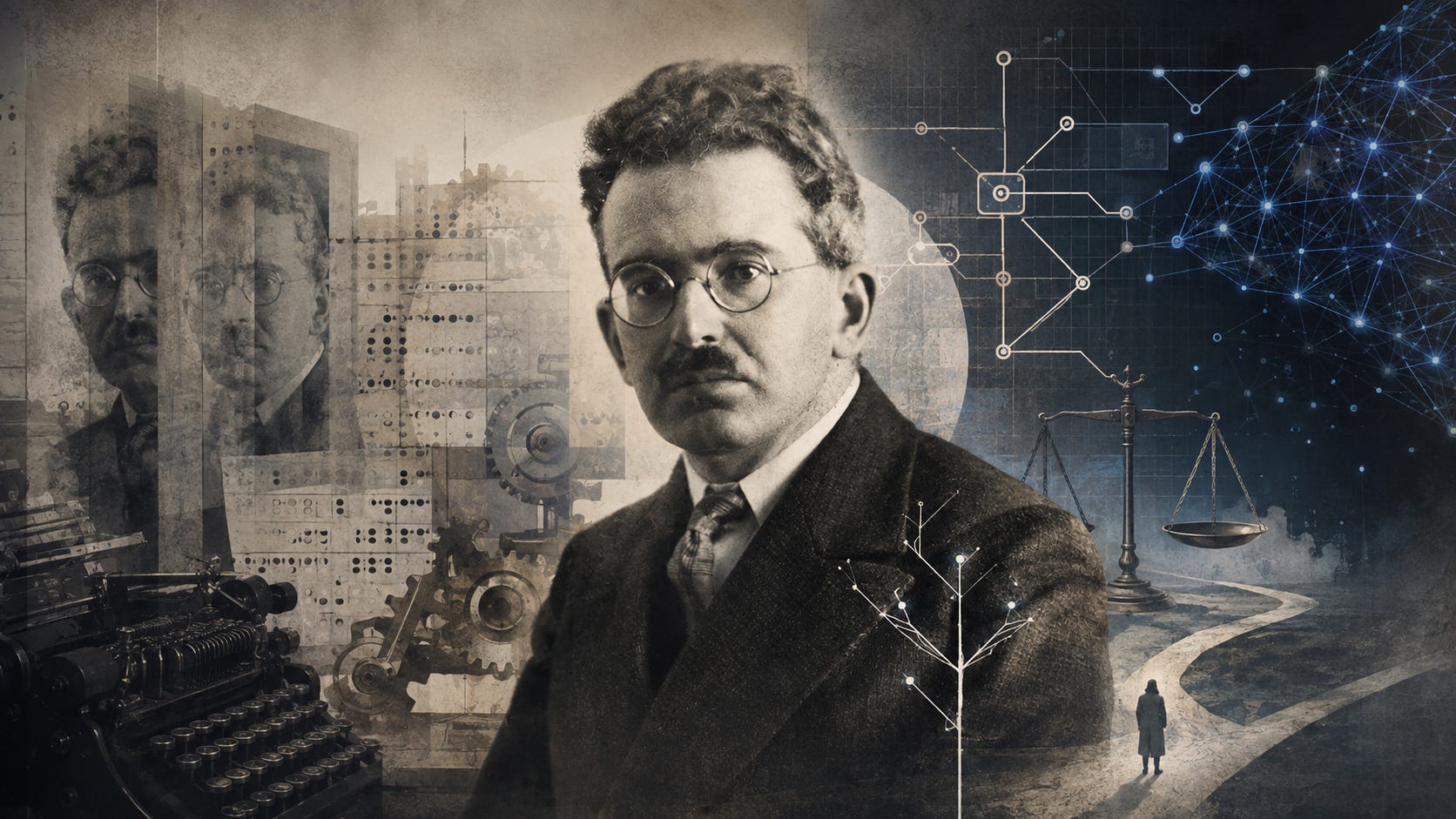
I. Paris, 1935
In 1935, in exile in Paris, Walter Benjamin watched two young technologies do something stranger than copy pictures. Photography and film were not merely multiplying images of artworks; they were dissolving the thing that had made artworks matter in the first place. Benjamin gave that thing a name — the aura — and defined it as a work’s unique existence in time and space: this canvas, in this room, bearing the marks of this hand and the history of everything that had happened to it since. A reproduction could carry the image anywhere, but it could not carry the here-and-now. What withered under mechanical reproduction, he argued, was precisely that singularity.
Lesser critics stopped there and mourned. Benjamin did not, and this is why we still read him. He saw that the technology was not degrading art but reversing its social function. For millennia, the artwork’s value had been cult value: the statue mattered because it stood in the temple, seen by few, embedded in ritual. Once images could be reproduced without limit, authenticity ceased to be a usable criterion, and the work’s basis shifted from ritual to something else entirely — to exhibition, to circulation, and ultimately, Benjamin argued, to politics. The question was no longer is this the true object? but what is this object doing among the people who now see it?
And he ended with a warning rather than a celebration. The emancipation of art from ritual did not guarantee a good successor. It opened a contest. One outcome was art placed in the service of collective self-understanding. The other — the one he watched winning across the border in Germany — was spectacle offered to the masses in place of power: politics turned into aesthetics, participation replaced by the feeling of participation. The technology forced the change; it did not choose the winner.
Ninety years later, we are living through the same event, one level up. The technology is generative artificial intelligence, and the thing losing its aura is not the artwork. It is the argument.
II. The Aura of the Argument
For most of human history, an intellectual object carried its provenance inside itself. A rigorous proof, a well-built legal memo, a working program, a strategy document that anticipated its objections — each of these could exist only because a competent mind had labored over it. The object was a fossil of the thinking. You could read the artifact and infer the mind, the way a paleontologist reads a footprint and infers the animal.
Every institution of intellectual life is built on that inference. The essay proves the student learned. The dissertation proves the scholar can contribute. The memo proves the analyst understood the problem. The byline, the degree, the publication record, the signature at the bottom of the page — all of them are certificates whose underlying collateral is the difficulty of production. Making the thing was hard; therefore the thing’s existence testified to competence. Scarcity did the epistemic work, silently, for so long that we forgot it was doing any work at all.
That is the aura of the argument: the trace of the particular mind that had to labor for the artifact to exist. And it is withering on exactly Benjamin’s schedule.
A machine can now produce the essay, the memo, the proof sketch, the plan, the code, and the strategy — fluently, in seconds, in unlimited quantity. The artifacts have not gotten worse. Many have gotten better. What has broken is the inference from artifact to mind. The student’s essay no longer proves the student thought. The consultant’s deck no longer proves the consultant understood. The fluent, structured, caveated analysis no longer testifies to anyone who could defend it under questioning, because fluency, structure, and caveats are precisely what the machines mass-produce. The footprint remains; the animal is optional.
Notice what has actually been lost. Not thought — there is more reasoning in circulation than at any moment in history. What is lost is the evidentiary function of intellectual production. Just as the photograph destroyed the painting’s monopoly on likeness and thereby forced painting to discover what else it was for, mechanical reasoning destroys production’s monopoly on proof-of-understanding and forces us to discover what human thinking is for.
III. Two Temptations
Faced with the withering of an aura, a culture reaches for one of two comforts. Benjamin catalogued both, and both have already reappeared.
The first is restoration: defend the aura by force. In art, this took the form of a theology of pure creation — art for art’s sake, the cult of the artist’s hand, authenticity fetishized precisely as it became untestable. In thought, it takes the form of detection and prohibition: ban the machines from the classroom, watermark their outputs, build detectors to catch the synthetic essay, redesign every assessment to be machine-proof, and thereby preserve the scarcity of intellectual production by statute. Some of this is tactically sensible in narrow settings. As a civilizational strategy it fails, and it fails for a revealing reason: it defends the proxy instead of the thing. We never valued the labor of writing memos for its own sake. We valued what the labor evidenced. A rule that preserves the labor while the evidence-relation stays broken produces the worst of both worlds — expensive artifacts that still prove nothing.
The second temptation is abdication, and it is the dangerous one because it feels like progress. If the machine’s reasoning is fluent, comprehensive, and usually right, why not let its outputs stand as conclusions? Let the generated analysis become the analysis; let the drafted policy become the policy; let fluency become institutional truth by default, because no human has time to check. Every organization on earth is currently sliding toward this equilibrium, one unexamined document at a time.
Benjamin has a name for where that slide ends. His deepest fear was not reproduction itself but the aestheticization of politics: spectacle standing in for self-governance, the image of collective life replacing its exercise. The corresponding fear today is the aestheticization of cognition. An organization can be fully decorated with the appearance of thought — reports, dashboards, risk assessments, strategic reviews, all generated, all plausible, all binding no one — while the actual exercise of judgment quietly stops. Call it reasoning theater: the institution lookslike it is thinking, the way a fascist rally looked like the people ruling. From the outside, and even from the inside, the difference is invisible until reality submits its invoice.
Between restoration and abdication there is a third path, and it is the one Benjamin’s own analysis points to. Reproduction did not eliminate art; it relocated the significance around art. Mechanical reasoning will not eliminate thought; it will relocate the significance around thought. The task is to choose the destination — and then, because significance does not move by itself, to build the vehicle.
IV. From Authorship to Ratification
Here is the relocation, stated plainly. When reasoning was scarce, authority attached to producing it. Now that reasoning is abundant, authority must attach to governing reliance on it. The defining human intellectual act shifts from “I made this” to “I examined this, I understand what it depends on, and I am prepared to stand behind our reliance on it.” The signature survives, but its meaning inverts: no longer a claim of origin, it becomes a claim of answerability.
It is worth pausing on why this act, unlike production, does not simply fall to the next wave of automation. A tempting story says it does: first the machines generate, then they select among generations, then they help specify the values that guide selection, and the human perch shrinks with every rung. That story is a god-of-the-gaps theory of human relevance, and it deserves the same fate. It runs together two things that are different in kind.
Selection — filtering, ranking, summarizing, even drafting eloquent statements of what we value — is computation, and computation gets automated. Ratification is not computation. To ratify a claim is to become the person who answers for it: who can be questioned, credited, blamed, trusted, or fired on its account. Answerability requires a bearer — someone with standing to lose. A machine can be turned off, but it cannot be held responsible, because holding-responsible is a relation among members of a moral community, not a property of outputs. And ratification cannot be delegated away, only relocated: hand the signing to a machine and you have not automated the signature — you have moved it to whoever decided to hand it over, whether or not they noticed. The human role in the age of mechanical reasoning is therefore not a shrinking perch. It is a different kind of act. Ranking is a calculation; standing behind is a commitment.
So the practical architecture follows in four lines.
Machines may generate abundantly.
Humans govern reliance selectively.
Reality retains veto power.
And the reasoning survives the particular machine that helped produce it.
V. The Anatomy of a Judging Institution
Architecture in four lines is a slogan; institutions live or die in the details of who does what at which moment. The right way to design the institution is to ask what each person in it needs, at the moment they need it — not to start from the data model and hope the humans adapt. Walk through the moments.
The moment of thinking. A person in the middle of a hard argument should not also be its clerk. The 1990s tried structured-reasoning tools and they died precisely here: they taxed the thinker to feed the record, so thinkers stopped feeding it. The machine now works cheaply enough to reverse the burden — it extracts the claims, surfaces the assumptions, notices the contradictions, and maintains the structure, while the human stays in the argument. But one gate is non-negotiable: when the machine restates what someone said, the person must be able to see the gap between their words and the machine’s version in seconds, and correct it in seconds more. The paraphrase is the point where institutional truth gets quietly rewritten. Guard it.
The moment of signing. When a person is asked to stand behind a claim, the institution must make genuine examination cheap: assemble, in one view, what the claim rests on — its evidence, its assumptions, the strongest objection anyone raised — so that examining takes minutes rather than archaeology. And it must make the signature cost something, socially. This is the correction that the optimistic story misses: prestige does not migrate to judgment on its own. If signing is a click, people will click, and ratification will decay into ceremony within a quarter. The quality of a person’s examination has to be visible, and reputations have to be built on calibration — on the record of what someone vouched for and how it fared — rather than on the volume of what they produced. An institution that cannot make careful judgment a source of status has not relocated significance; it has abandoned it.
Apropos signing:
This essay was developed through extensive collaboration with AI, including drafting and revision. I selected, challenged, rewrote, and ratified the argument, and I stand behind the final text.
The moment of dissent. In ordinary organizations, an overruled objection survives as a corridor conversation and a grudge. In a judging institution, dissent is a standing position: recorded, attached to the claim it contests, requiring no further fighting to stay alive — and if reality later vindicates the dissenter, the record says so without anyone having to say “I told you so.” This is not sentimentality. Minority positions are an institution’s insurance policy, and an institution that makes dissent expensive to maintain is buying its consensus at the cost of its memory.
The moment of inheritance. The new hire, the successor, the same team six months later — they encounter a decision they did not make, and they need to distinguish three states that ordinary documents render identical: settled for good reasons, settled arbitrarily, and never actually settled. A judging institution preserves the structure of past reasoning — what depended on what, who accepted what, what would have changed the outcome — so that the distinction takes minutes to recover. The measure of success is negative space: the relitigation that doesn’t happen, the blind deference that doesn’t happen. And this is what makes the whole record consequential rather than a graveyard: it gets consulted because consulting it is faster than asking around.
The moment reality answers. Whenever reasoning drives consequential action, the institution must expose it to the world before the world replies on its own schedule: record what is expected to happen, by when, under what conditions, and what result would force reconsideration. Then the system’s manners change — it stops serving people and starts imposing on them, politely. It brings the prediction back at the appointed time whether or not that is convenient. It makes people record what happened before they are allowed to argue about why, so the observation survives the storytelling. And when a claim fails, it shows everything that leaned on the claim, so that changing the institution’s mind is targeted and bounded rather than diffuse and deniable. Done well, this reframes belief revision as a demonstration of competence — look how precisely we can correct course — rather than a hunt for who was wrong.
Every moment at once. Cutting across all of these is the constraint the entire architecture answers to: machine-generated reasoning now exceeds, permanently and by orders of magnitude, what any human could examine. Human attention is the scarce resource the system exists to protect. So the institution must ration it — surfacing only the changes that genuinely need a person, ranked by how much is riding on them. Everything the system shows a human unprompted is a withdrawal from the one account that cannot be refilled.
Fuse the signer’s moment and the inheritor’s moment and you get the institution’s master function, the sentence every design decision must serve: make it cheaper to know what we believe, why, and who stands behind it than to not know. Every feature either feeds that sentence or defends it.
VI. What the Institution Must Refuse
An institution is defined as much by what it declines to do, and this one will be constantly invited to do three adjacent things that would kill it.
It must refuse to author. The moment the governing layer generates the reasoning it exists to govern, ratification collapses into the machine grading its own homework, and the signature means nothing again. Generation and governance can share a building; they cannot share an office.
It must refuse to surveil. If contributors experience the capture of reasoning as management reading over their shoulders, they will route their real thinking around the system, and the institution will possess a pristine, comprehensive record of trivia. The record must belong, first, to the people reasoning in it.
And it must refuse to become a compliance archive. There is a customer for the appearance of governance — the organization that wants to be seen to have examined its machine-assisted decisions without bearing the cost of examining them. Serving that customer well is how such a system succeeds commercially while failing existentially. It is reasoning theater with a subscription fee.
Which yields the single diagnostic question a leader should ask of any such system, including one already installed: what are its practical implications? Do failed predictions actually cause upstream edits, and do those edits actually change actions? If yes, the institution has bought governance. If no, it has bought furniture.
VII. The Politics of Mechanical Reasoning
Benjamin closed his essay with politics, and so must we, because the stakes here are not managerial.
Reasoning capacity is becoming infrastructure, provided by a small number of systems owned by a smaller number of firms. In that world, access to generation will matter less every year — generation is the thing becoming cheap. Three other goods will matter far more, and all three concentrate by default.
The first is the power to set objectives: who defines the questions the machines work on, the constraints they honor, the consequences they are permitted to entail. The central political struggle of the coming decades will not be over who gets answers. It will be over who writes the questions.
The second is verification capacity. Judging machine reasoning at scale requires exactly the institutional machinery described above, and that machinery can be as unequally distributed as the generators themselves. A society in which a few actors can afford to examine what they rely on, while everyone else must take fluency on faith, has not democratized intelligence. It has aristocratized judgment.
The third is portability, and it is the least discussed. If an organization’s accumulated reasoning — what it believes, why, what it tried, what failed — lives inside one provider’s model, memory, and conversational history, then leaving that provider means losing part of the organization’s mind. That is not a procurement inconvenience; it is a dependency relation, which is to say a power relation. The countermeasure is architectural: the reasoning must survive the particular machine that helped produce it. Models should be replaceable participants in an institution’s inquiry, never the owners of its accumulated thought. An institution should be able to fire its model without losing its mind — and a civilization should insist on nothing less.
Here Benjamin’s epilogue transposes almost without modification. The emancipation of reasoning from labor opens a contest. On one side: institutions that subject machine intelligence to collective judgment — that keep the questions, the reliance, and the accountability in human hands, with an address where responsibility can land when a machine-assisted decision fails. On the other: the aestheticized alternative, in which populations are surrounded by magnificent reasoning they neither govern nor examine, offered the feeling of understanding in place of its exercise. The technology forces the change. It does not choose the winner.
VIII. The School and the Failure Mode
The soberest sentence one can write about this transition is a conditional: if we automate the production of reasons before we learn to judge reasons, we will build a society surrounded by intelligence and increasingly incapable of exercising it.
The usual response is to call for education, and education is necessary — a curriculum for the ratifying mind would teach the skills this essay has been circling: reading an argument for its pivotal assumptions, locating the strongest objection, calibrating one’s confidence against one’s record, knowing what would change one’s mind. But education alone individualizes a structural problem. No curriculum produces a person who can examine machine-scale output unaided, any more than literacy produces a person who can read the whole library. Judgment at scale is not a personal virtue. It has to be housed. Institutions are how a civilization judges — how it rations its attention, remembers its dissents, keeps its promises to check its predictions, and makes its signatures mean something. The school and the institution are the same project at two scales, and the second is the one we have barely begun.
Which suggests the honest way to begin: small. Not a reformation of education, professional authority, and prestige by decree, but bounded institutions where consequential reasoning already happens and the cost of bad judgment is visible — a clinical review board, an investment committee, an engineering organization, a court of first instance. Build one working micro-institution in which the new division of labor actually functions, and measure it without mercy: whether humans spend less time on the clerical work of reasoning, whether they can reconstruct past decisions faster, whether disagreements survive, whether predictions get revisited, whether evidence causes belief revision — and whether the practice outlives its founders. The experimental question is no longer whether machines can reason. Plainly they can produce ever more sophisticated representations of reasoning. The question is whether we can make the representational work of reasoning cheap enough that scarce human attention moves upward into judgment, verification, accountability, and learning — without that judgment becoming an unbearable bottleneck, and without it decaying into theater.
IX. What Withers, and What Can Grow
Benjamin was right about his century. The aura of the artwork withered, and art did not die; the significance around it moved — into new forms, new publics, new arguments about what images were doing in the world. He was also right that the move was not automatic. It was contested, and in his lifetime the wrong side was winning.
The aura of the intellectual artifact is withering now. The essay, the memo, the proof, the plan — these will never again testify, by their mere existence, to a mind that labored. Mourning this is understandable and useless. The scarcity was always a scaffold, and the scaffold has come down; the question is what we build where it stood.
What can grow is a practice — and, if we are serious, a generation of institutions — in which humans inherit machine-abundant reasoning rather than being buried by it: contest it, ratify it, expose it to reality, revise it precisely when it fails, and remain answerable, by name, for what they choose to believe and do. In that practice, human dignity is not diminished by the machines’ fluency, because dignity was never really in the making. It was in the standing-behind. The age of mechanical reproduction asked what art is for when anyone can have the image. The age of mechanical reasoning asks what thought is for when anyone can have the argument. The answer is the same shape Benjamin found: not the object, but the act around the object. Not I made this — that sentence now belongs to the machines, and they are welcome to it. The sentence that remains ours is harder, older, and better: I examined this, I know what it rests on, and I answer for it.
To follow this argument, from essay to experiment, subscribe below.
If this changed how you think about AI and human judgment, pass it on!